Deep Sea Fishing in Punta Cana, Planned from Itza
Deep sea fishing in Punta Cana works because the deep water begins close to land. The Mona Passage, 80 miles of open sea between the Dominican Republic and Puerto Rico, runs past the island's eastern tip, and its submerged banks pull in the bait that big fish hunt. For an owner at Itza Golden Residences in Cap Cana's Golden Lakes, the boats leave from Marina Cap Cana, 3.1 miles away by road. This guide is about the fishing itself: where the fish hold, which ones come home for dinner, which ones must go back, and how to shape the day.
Why is there deep water so close to Punta Cana?
Punta Cana sits on the easternmost point of Hispaniola, where the Caribbean meets the Mona Passage, the 80 miles of open water separating the Dominican Republic from Puerto Rico. A Saltwater Sportsman feature on offshore fishing here describes the passage as water whose mood can change fast, and explains what makes it productive: submerged banks, which local crews call the rocks, climbing from a surrounding depth of 1,000 feet to within 300 feet of the surface. Bait holds over the tops of those banks, and the marlin hunt it there.
The practical result is a short run to fishable water. The same feature describes one captain's favourite spot about 12 miles out, and the writer felt he was among marlin almost as soon as the boat cleared the harbour mouth. Not every trip goes that far or in that direction: the captain reads current, weather and feeding birds on the day and picks the grounds to match.
What can you catch, and what comes home for dinner?
An offshore day off Cap Cana is mostly trolling: lures or rigged baits pulled behind the boat while the crew watches the spread. Three fish make up most of what comes home. Mahi-mahi, sold as dorado in Dominican fish shops, often travels under floating weed and diving birds; wahoo strikes fast-moving lures and has teeth worth respecting; yellowfin tuna hunts in schools. A charter-booking marketplace's 2026 guide calls all three good eating. The billfish, blue and white marlin and sailfish, are the trophies, and they are released.
The months below are that marketplace's. Marina Cap Cana's own calendar marks some species differently, so treat both as a starting point and ask the captain what has been biting in the week you plan to go.
| Species | Typical size | When the guide says to go | Keep or release |
|---|---|---|---|
| Mahi-mahi (dorado) | 10 to 90 lb | All year; most numerous October to April | Can be kept; agree it with the crew |
| Wahoo | 10 to 120 lb | All year; October to December for a big one | Can be kept; agree it with the crew |
| Yellowfin tuna | 20 to 50 lb, some over 100 lb | Most active in January and February | Can be kept; agree it with the crew |
| Sailfish | Not given | November to February | Released |
| Blue marlin | Not given | June to late September, best in August | Released |
| White marlin | Not given | Late spring to late August, best in June | Released |
Which fish have to go back in the water?
Two different rules decide what is released, and they come from different places. The first belongs to the marina: Marina Cap Cana calls itself a catch-and-release marina and lists membership of the Billfish Foundation, so a marlin or a sailfish caught from its docks is brought alongside and set free, and its tournaments are fished the same way. That is the marina's policy. It is not a statement about what Dominican law says about billfish, and this page makes no such claim.
The second is national. In June 2017 the Ministry of Environment announced Resolution 023/2017, which prohibits fishing for every species of shark and ray in Dominican waters, for an indefinite period. A shark that grabs a trolled bait is unhooked or the line is cut, and it is not brought aboard to keep. If a crew suggests keeping anything you are unsure about, ask before it comes over the rail.
Half a day or a full day offshore?
The marina's charter request form runs from half a day up to four days, and the length you choose shapes the fishing. Because the banks lie close, a half day is a genuine offshore trip rather than a cruise along the beach, and it suits a first outing, children, or anyone unsure how they will handle a swell. A full day buys range: time to run to grounds farther out, work a weed line for mahi-mahi in the morning and still troll for billfish in the afternoon.
-
Plan around the least seasoned sailor The Mona Passage can turn lumpy with little warning. If anyone in the group has never been offshore, start with a half day and stretch to a full day once you know how they fare.
-
Say what you are after The form asks for the group's experience, from rookie to pro. Add whether you want fish for the table or a shot at a marlin, because the crew sets lures and picks grounds around that answer.
-
Get the inclusions in writing No rates are published, so request a quote and ask whether fuel, bait, tackle, drinks and lunch are in it, how many anglers the boat takes, and who fillets and bags the fish you keep.
-
Allow for the weather Sailors' reports describe the Navy keeping boats in port when it judges the sea unsafe. Ask how the booking moves if that happens; hurricane season runs from 1 June to 30 November.
-
Let the charter carry the permits A charter-booking marketplace says the charter covers the fishing permits for its own trip. Fishing later from a boat of your own is a separate question for CODOPESCA, the Dominican fisheries council.
What should you bring on board?
Ask whether rods, tackle and bait are aboard; then pack what a boat rarely carries for you. Sun protection that survives spray, a hat that ties on, polarised sunglasses for spotting weed lines and fish, a light long-sleeved layer, and soft-soled shoes that grip a wet deck. Take any motion-sickness remedy before leaving the dock rather than once the boat starts to roll, eat a light breakfast, and keep your eyes on the horizon on the run out.
Have a passport or cédula number to hand when you book, since the marina's form asks for one. And leave an insulated cooler bag in the car: with the boats 8 minutes from the towers, the fillets reach the kitchen while still cold.
From the boat to the table at Itza
The real reward of a mahi-mahi or wahoo day is dinner. Along the Dominican coast the classic treatment is fried fish with tostones, slices of green plantain fried twice, which the Ministry of Tourism describes as a fixture of beaches where the catch of the day is served. At home a fresh fillet needs little more than lime, garlic and a hot pan.
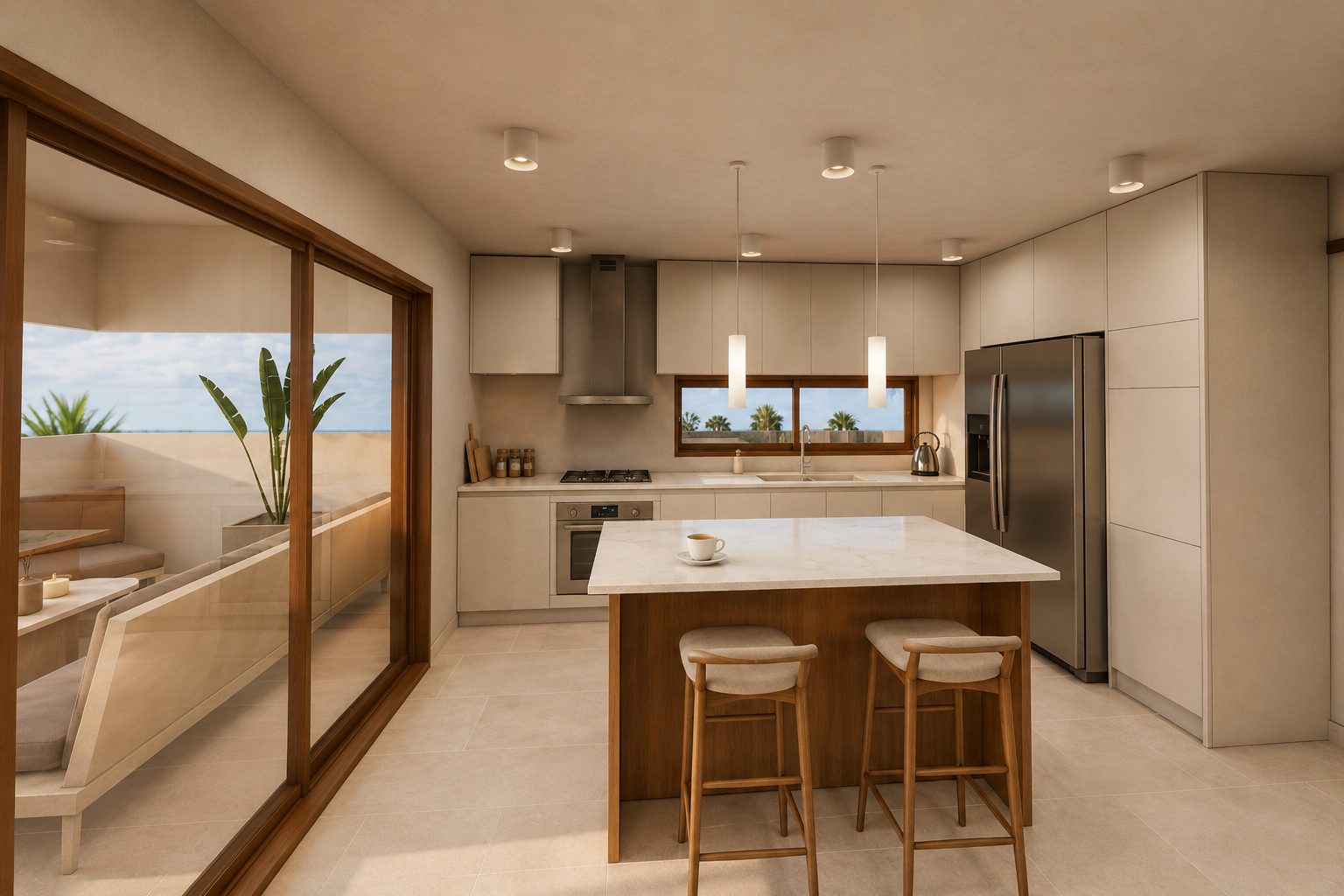
The developer's renderings show Itza's residences with island kitchens like the one pictured above, so a morning offshore can end with the catch on your own table that evening. For owners who rent their residence out, a fishing day is also a question guests ask, and the answer from Itza is a short one: the boats are 8 minutes from the door.
How does offshore fishing fit with life at Itza?
Itza is 52 residences in four stepped towers beside a navigable lake in Golden Lakes, and that lake is kept for water sports without engines: paddles and sails rather than outboards. That makes the division easy to live with. Calm water lies at the foot of the towers, and the deep water of the Mona Passage is a short drive and a short run away. Nobody needs a boat of their own to fish it from here. For buyers who plan their year around the sea, that pairing, rather than a dock below the balcony, is what this address offers.
Common questions
- How far offshore do deep sea fishing boats go from Punta Cana?
- It changes with the day. A Saltwater Sportsman feature describes submerged banks in the Mona Passage rising from 1,000 feet of water to 300 feet below the surface, with one captain's favourite spot about 12 miles out. The captain chooses the grounds by weather and current.
- Can I keep the fish I catch on a Punta Cana charter?
- Table fish such as mahi-mahi, wahoo and yellowfin tuna can be kept by agreement with the crew. Marlin and sailfish are released under Marina Cap Cana's catch-and-release policy, and a 2017 resolution bans fishing for sharks and rays nationwide.
- Is a half-day deep sea fishing trip worth booking from Cap Cana?
- Often, yes. The productive banks lie close to the coast, so a half day reaches real offshore water. The marina's request form offers trips from half a day to four days.
- When is mahi-mahi season in Punta Cana?
- A charter-booking marketplace's 2026 guide says mahi-mahi are around all year and most numerous from October through April, with a typical fish weighing 10 to 90 lb.
- How long is the drive from Itza to the fishing boats?
- Marina Cap Cana is 3.1 miles by road from Itza Golden Residences, about 8 minutes by car.
Want the details for your own situation?
Ask about availability, layouts or the buying process, and someone from the sales team will get back to you.
Get in touch